

Spring Is Coming — And With It Comes Growth
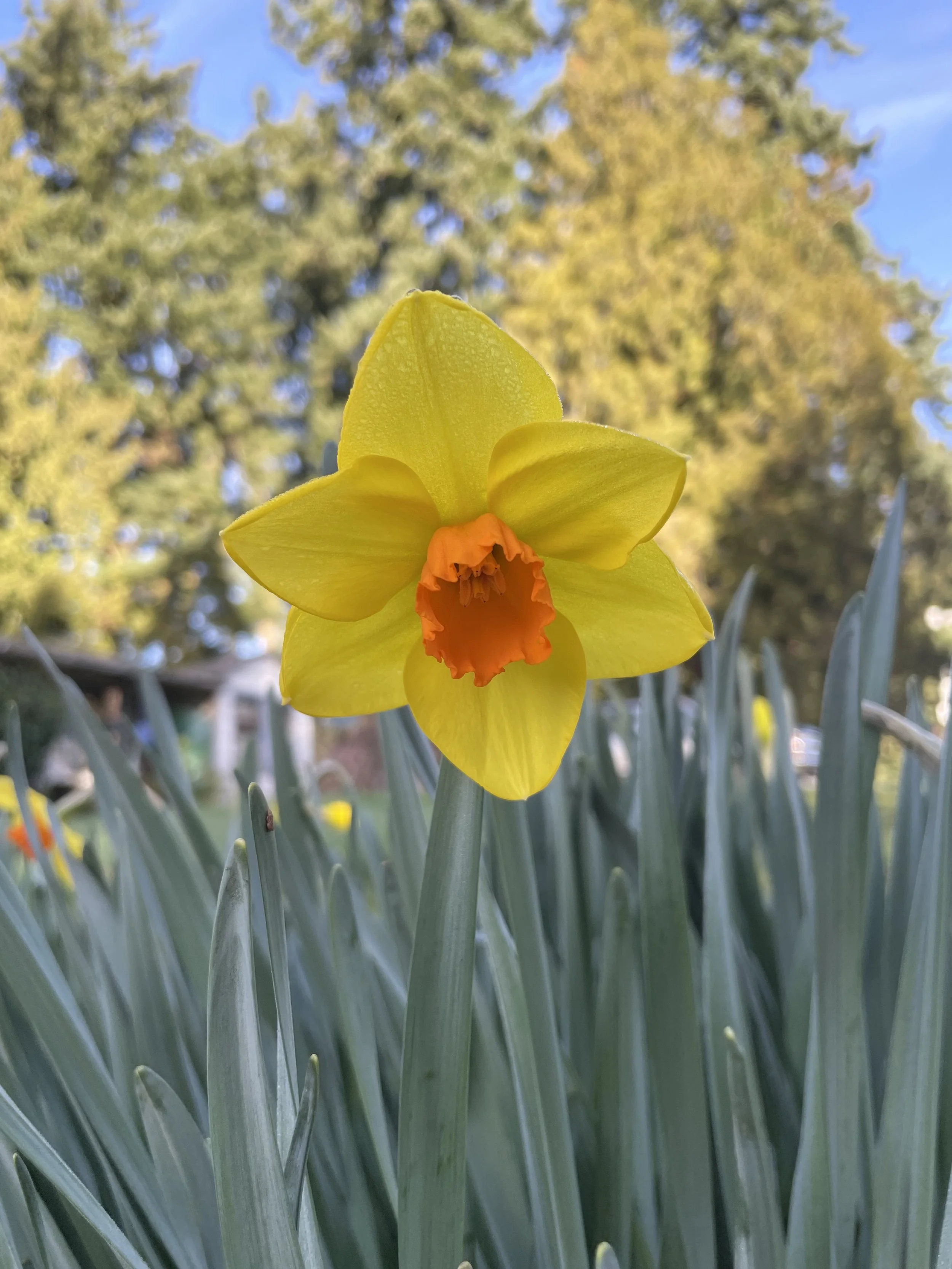
The daffodils in my yard are starting to bloom.
Every time I walk outside, I notice something new — tiny green shoots pushing through the soil, blossoms forming on the trees in our neighborhood, the light lingering just a little longer in the evenings.
Spring is officially only a couple weeks away.
And I couldn’t be more excited.
I love the darker/colder months too, but there’s just something about Spring.
It’s just so full of newness. There’s growth all around us. It’s hard not to be affected by it. It makes you want to Spring clean your house, organize all the things, and restructure how you’re spending your days. Or at least that’s what it does to me.
It feels like the real beginning of the year.
I’ve shared before that I think starting the year in January is a terrible idea. January is not when anything new happens in nature. It’s the dead of winter. Everything around us is in hibernation. It’s dark, it’s cold. It’s stay-inside energy, not go-out-and-conquer energy.
But culturally, January is when we’re told to overhaul our lives. New year. New habits. New routines. New you.
Biologically though, January is when our bodies are still conserving energy. Lower light exposure affects dopamine and serotonin. Cold weather shifts us inward. Our nervous systems are wired for preservation at this time — not expansion.
It’s like trying to plant seeds in frozen ground and then feeling confused when nothing grows.
But Spring is different.
Spring brings light. Longer days. More desire for movement. Subtle shifts in energy and purpose.
Nature doesn’t bloom in January. It waits for the right conditions that will support growth.
And as biological creatures, we are not separate from nature. Which means right now — as the light shifts and the daffodils push up through the soil — we’re entering a season that actually supports change, that supports new.
Starting new habits or goals in Spring makes so much more sense than January. But even though the timing might be just right, habits can still be really tough to change! Timing is only part of it. You also have to know how to actually create habits that stick.
There’s a common problem I see so many women run into — especially highly capable women who know what to do, but can’t seem to follow through. Women juggling chronic stress while trying to do all the things.
This is something I’m very passionate about because I lived in this cycle for a long time.
The Endless Cycle
Here’s what happens:
We decide that now is a good time to make some changes. We’re excited and we’re extremely motivated. We’re determined that this time, I will be consistent. This time, it will definitely stick.
So we set goals. We buy the planner. We make the list. We decide we’re going to wake up earlier, move our bodies, eat better, journal more, scroll less.
For a few days, it feels exciting. We’re doing the thing. We’re committed to being a new person this time.
And then… Life happens. Work gets stressful. The kids get sick. You sleep badly. You miss one day. Someone needs you and your schedule gets thrown out the window. These are all inevitable.
But here’s the real reason why it throws everything off balance:
Almost immediately, when you can’t do it perfectly, the thoughts creep in:
“Why can’t I ever stick with anything? I know what to do. I just can’t seem to make myself do it.”
Now you’re filled with shame. All your motivation is gone. The only thing you want to do is climb back into bed and hibernate for a bit longer.
You give up on it all because what’s the point? And then you stay in that wallow space for a few days, weeks, or even months, until you get tired enough that you decide to try again.
But the cycle only repeats.
If you’ve ever found yourself stuck in that loop, you’re definitely not alone.
And despite what you’ve been telling yourself about why this keeps happening — this is not a character flaw. It’s not a self-discipline issue either. It goes much deeper than that.
Change Is State-Dependent
When you’re calm and regulated, your prefrontal cortex — the part of your brain responsible for planning, decision-making, and long-term thinking — is online. You can think about the future and make plans. It’s easier to delay gratification because you see the short term and long term effects. You’re able to follow through even if it feels hard.
But when stress rises, cortisol increases. And when cortisol increases, prefrontal cortex activity decreases and your survival brain takes over. When this happens, your system prioritizes what’s familiar, what’s efficient, what gives immediate relief.
That’s why scrolling feels easier than journaling. Why sugar feels easier than protein. And why avoiding feels easier than starting.
Motivation isn’t a fixed trait that we’re born with. It’s entirely state-dependent.
If you’ve been trying to build new habits on top of chronic stress, nervous system dysregulation, exhaustion, or overwhelm… of course it feels impossible. Your body is focused on safety. And that’s as it should be. That’s not your body malfunctioning. It’s prioritizing safety over growth.
And that is the furthest thing from weakness.
“But Deborah .. that’s not acceptable. Why can’t I just override my nervous system and choose these habits anyway? They’re the things that will actually address what’s wrong!” That was my thinking for a long time too. I knew what to do to make myself feel better and yet I couldn’t stick to any of it. But as I said, this isn’t a character flaw or lack of desire. It's a misunderstanding of how habits work in the first place.
Your Brain Prefers the Familiar — Even If It’s Unhealthy
We tend to think of habits as strictly conscious choice fueled by willpower, but the reality is that habits are neural pathways. Every time you repeat a behavior, you strengthen that pathway. Over time, it becomes more and more efficient. It eventually becomes automatic.
You most definitely have certain habits that you’ve been doing so long that they’re now mostly subconscious and you do it without even thinking about it.
Old habits are like clear, open highways in your brain. It’s a road you’ve driven so many times that you know every turn, every sign, every stop.
New habits are like unpaved trails through tall grass. You can do it, but you need to watch each step closely. There are trip hazards. It takes so much more effort, and it’s easy to lose your way.
This is why habits are so difficult to break and why they’re so difficult to start.
When you’re stressed or tired, your brain chooses the highway. Not because you don’t care, but because your brain always chooses efficiency.
Change requires more energy, and if your system already feels depleted, your brain will resist anything that could only deplete you further. Even if it will benefit you long term. Immediate survival always takes priority.
The Subconscious Safety Check
Here’s the reality of what’s going on inside:
Every time you attempt change, your nervous system runs a subconscious safety check:
Is this predictable?
Is this sustainable?
Is this going to cost too much energy?
Will this make me feel like I’m failing again?
If the goal feels too big…
If it threatens your identity…
If it feels like pressure or threat…
Your system hesitates, and quite often pulls out all the stops to prevent you from moving forward. That can feel like sabotage — like you don’t actually want to get better.. But that’s not it at all. You’re preventing forward movement because the change feels dangerous. So it’s not really sabotage. It’s protection.
This is exactly why inside Rooted + Rising we focus on building habits through safety first — not pressure.
The Shame Loop That Keeps People Stuck

I lived this for so many years. And believe me, it was incredibly frustrating.
This was my process over and over again:
Set a big goal.
Miss a day.
Feel disappointed.
Criticize myself.
Avoid it entirely.
This is the classic shame loop that so many people find themselves stuck in:
Miss a day → Self-criticism → Stress response → Avoidance → “See? I never follow through.”
But here’s what’s actually happening neurologically:
The shame that comes up after you don’t stick to your new goal increases your stress hormones. Those stress hormones then decrease executive function (motivation, planning, focus). Executive function is required for consistency.
So basically, shame sets you up for failure. Shame biologically reduces your ability to follow through. And the more pressure you apply, the harder it becomes.
Which is why so many intelligent, capable women end up feeling so stuck. It’s not because they don’t want it enough, it’s because they’ve been trying to build change through pressure instead of safety.
The Dopamine Piece
I’m going to write an entire blog on dopamine soon because it deserves an entire article, but here’s what you need to know for now:
You’ve likely heard dopamine called the “pleasure chemical,” but it’s more accurate to think of it as the drive chemical. Dopamine motivates pursuit. It helps you move toward something.
But here’s the piece we need to understand: Dopamine drops under chronic stress. It drops when goals feel too big or unreachable. It drops when effort doesn’t feel rewarded easily enough.
When we set big goals, we might get short term spikes of dopamine because we’re moving toward something worthwhile, but then we crash because the payoff doesn’t come fast enough.
There are a lot of reasons why our dopamine can be low or off balance. But as far as its impact on starting new habits, the role of dopamine is part of why trying to overhaul everything overnight doesn’t work. This is why I focus so much on small wins in all my teachings. Because small wins are what actually sustain momentum.
Spring Is About Conditions — Not Force
Are you feeling the desire to set some new goals this Spring? Maybe you’ve already started.
Here’s the part to keep in mind: forcing growth only stunts it. We have to create the right conditions to support it.
Here is the recipe for change that actually sticks (and I know it works because I’ve been using it for years now):
When setting a new goal, choose tiny steps first. Start small. So small it feels like not enough.
Focus on consistency, not intensity.
Build rhythms. Don’t worry so much about the results you’re getting now, focus instead on building that new neural pathway every day.
Allow for missed days. They’re going to happen. Simply start again as soon as it’s possible, without any pressure.
If it feels too hard at any point, it just means you’re moving too fast. Take smaller steps, and trust the process. When our approach takes into consideration what makes the nervous system feel safe, that’s what allows for change to be possible.
Just imagine missing a day and not spiraling because of it. Imagine building habits without self-criticism being a part of the process. Imagine not starting over every few months.
If you’re reading this and thinking, “okay, I want that, but I don’t know how to make this work for my life,” then I have something for you.
March inside Rooted + Rising we’re focused on creating habits that work with your nervous system — not against it.
This week I’m teaching a Masterclass called: Habits That Heal: Building Consistency Without Burnout. We’re going deeper into:
Why motivation fades under stress
The neuroscience of habit wiring
Why the 21-day rule is a myth
How dopamine actually supports repetition
How to build habits your nervous system can sustain
And how to redefine success as returning
You’ll leave with practical tools to make this time of year a season of growth. You’ll learn how to start the habits that will help you to regulate your nervous system, but in a way that makes your nervous system feel safe.
In two weeks, we’ll also have a Coaching Call using Aroma Freedom Technique to gently rewire limiting beliefs around getting started. Often it’s the story we tell ourselves that keeps us stuck — and AFT helps you access the part of your brain capable of writing a new one.
You’ll also have a private Facebook group for support and accountability so you never feel alone.
All that for $27/month. No obligations, cancel anytime.
Ready to build habits your nervous system can trust?
Spring is coming. Let’s lean into all the possibilities that it brings with it.
About Deborah
I'm Deborah Cobb, an Integrative Health Practitioner (IHP) and a massage and craniosacral therapist (LMT, CCST) with over 20 years of hands-on experience. I spent years dealing with panic attacks no doctor could explain before I learned it was my nervous system, and now I teach people how to regulate theirs using my SAFE Framework.