What Your Brain Is Actually Doing While You Sleep
I woke up this morning feeling like I had barely slept. My body was stiff from spending the night on a mattress on the floor of my home office. I had a vague awareness of having checked the time approximately a hundred times, and my eyes had that groggy heaviness that usually means I went to bed way too late.
So I was surprised when I looked at my Oura ring and saw this: 7.5 hours of sleep. 1 hour and 51 minutes of REM. 1 hour and 21 minutes of deep sleep.
By the numbers, I had actually slept pretty well. But that’s not at all how I felt.

I went to bed expecting a sleepless night. I’m a bit of an overanxious cat mom, and yesterday we had our sweet orange tabby named Rusty neutered. Even though his procedure went great, I wanted to make sure he was managing okay with the cone, that his pain medication wasn't too much, and I honestly just couldn't bear the idea of him being alone all night. So I camped out on the office floor with him.
And I felt like I had an infant again. Every tiny movement, every small sound, constantly checking to make sure he was still there and breathing. I woke up with his feet in my face and while I was happy it was a mostly uneventful night, I was exhausted.
I'm sure you've had those nights. I'm grateful to sleep really well normally, but as I've gotten older it's crazy how impactful it can be when I just get one night of poor sleep.
But back to my sleep score. According to my Oura ring, I slept great. That's a decent amount of hours, and a decent amount of REM and deep sleep. So why does it feel like my brain is firing at half speed today?
It's because sleep isn't just about hours. Sleep has a very specific purpose and it's not just rest. There are a lot of things your body does when you sleep to help you feel renewed the next morning, but one of the most fascinating parts of sleep involves a brain process that most people have never even heard of: the glymphatic system.
The glymphatic system is your brain's cleaning system, and when it gets interrupted or doesn't have enough time to fully do its work, you will feel it.
The brain's blind spot
After spending over 20 years in bodywork, I'm very familiar with the lymphatic system. Even when I wasn't doing lymphatic-focused massage, it was always there in the back of my mind whenever I was in session, because any kind of bodywork is impacting the lymphatic system.. It's an incredibly underappreciated system — a whole network of vessels, nodes, and fluid that moves waste out of your tissues and supports immune function throughout the body. I've used Manual Lymphatic Drainage techniques for a very long time and am always amazed at the difference it can make.
For a long time, though, the brain was considered separate from this system.. Scientists believed it was "immune privileged" — since it was sealed off from the immune system, it didn't have any lymph vessels or any kind of lymph system. The assumption was that the brain simply didn't need one.
That assumption turned out to be wrong.
The discovery that changed everything
In 2012, a neuroscientist named Dr. Maiken Nedergaard and her team at the University of Rochester made a discovery that rewrote what we thought we knew about the brain. Using a new imaging technique in mice, they found something that had been hiding in plain sight: the brain has its own dedicated waste clearance system.
They named it the glymphatic system — a combination of glial cells (the brain's support cells) and the lymphatic-like function it performs. And then they found something that made the discovery even more significant: this system doesn't run continuously. It activates primarily during sleep.
Which actually sounds counterintuitive at first. Because your brain is producing metabolic waste constantly — it's one of the most active organs in your body, consuming roughly 20% of your total energy despite being only about 2% of your body weight.
But the main mechanism for clearing all of that waste is something that can only happen properly when you're asleep.
How it actually works
Think of your brain like a busy city running at full capacity all day long. Millions of tiny processes are happening simultaneously — every thought, every decision, every emotion, every memory being formed creates metabolic activity. And just like any busy city, all of that activity creates waste. The question scientists had been asking for decades was: How does all that waste get cleared?
The answer, unsurprisingly, turned out to be brilliant. During sleep, cerebrospinal fluid — the clear fluid that surrounds and cushions the brain and spinal cord — is pumped through channels that run alongside blood vessels deep inside the brain. It flows in, sweeps through brain tissue, and carries waste products back out through a separate drainage pathway. Think of it less like a drain and more like a river system running through the brain — but a river that flows most efficiently during deep sleep, when the city finally quiets down enough to let the cleaning crew through.
Here's the part that completely blew my mind when I first learned it: during sleep, your brain cells actually shrink slightly. Researchers believe this is one of the body's brilliant ways of making room for the brain's nightly cleanup. That tiny change creates about 60% more space between brain cells, opening up room for cerebrospinal fluid to sweep through the brain much more efficiently — like widening the aisles in a packed grocery store so the overnight cleaning crew can finally move through. It's that extra space that allows your brain's cleaning system to do work that simply isn't possible while you're awake.
The result? The glymphatic system is estimated to be about ten times more active during sleep than during wakefulness.
Ten times.
That's not a small improvement — it's a completely different level of activity.
During the day, your brain is essentially tidying as it goes. During deep sleep, it finally gets the space — and the time — to do a true deep clean.
The more I learn about the human body, the more evident it becomes to me that sleep isn't passive at all. It's one of the most biologically active things we do.
What it's clearing — and why that matters
So what exactly is all this cleaning accomplishing?
Scientists are still uncovering everything the glymphatic system removes, but two waste products have drawn the most research attention: beta-amyloid and tau proteins. Both accumulate in the brain over time, and both have been strongly associated with Alzheimer's disease and other forms of neurological decline. During healthy sleep, the glymphatic system clears these proteins efficiently. Under conditions of chronic poor sleep, they begin to build up.
The research is still developing. Science is exploring this connection, not drawing a straight line from poor sleep to disease. But what has been established is this: the accumulation of these proteins triggers neuroinflammation. And neuroinflammation doesn't stay contained in only one area. It activates the brain's threat-response systems, it dysregulates mood, it contributes to that wrapped-in-cotton feeling of brain fog and cognitive slowing — and for the people I work with — it keeps the nervous system in a low-grade activated state even when there's nothing external driving it.
Which brings us to the loop.
The nervous system connection
Chronic stress impairs deep sleep. Less deep sleep means less glymphatic clearance. Less glymphatic clearance means more accumulation of inflammatory waste. That inflammation signals the brain's threat-detection systems, which ramps up nervous system activation. And heightened nervous system activation makes deep, restorative sleep harder to reach.
Around and around it goes.
We often think improving sleep will calm the nervous system. But the opposite is equally true. A calmer nervous system is what allows truly restorative sleep to happen in the first place.
Your brain needs that deep sleep to clear the very things that would otherwise keep your nervous system in a heightened threat state. It's a beautifully interconnected system. You really can't address one without supporting the other.
And this is why, when it comes to improving sleep, the question I find most useful isn't "How do I force myself to sleep better?"
It's "What does my body need in order to feel safe enough to fully rest?"
Those are very different questions — and they lead to very different answers.
Back to my rough night
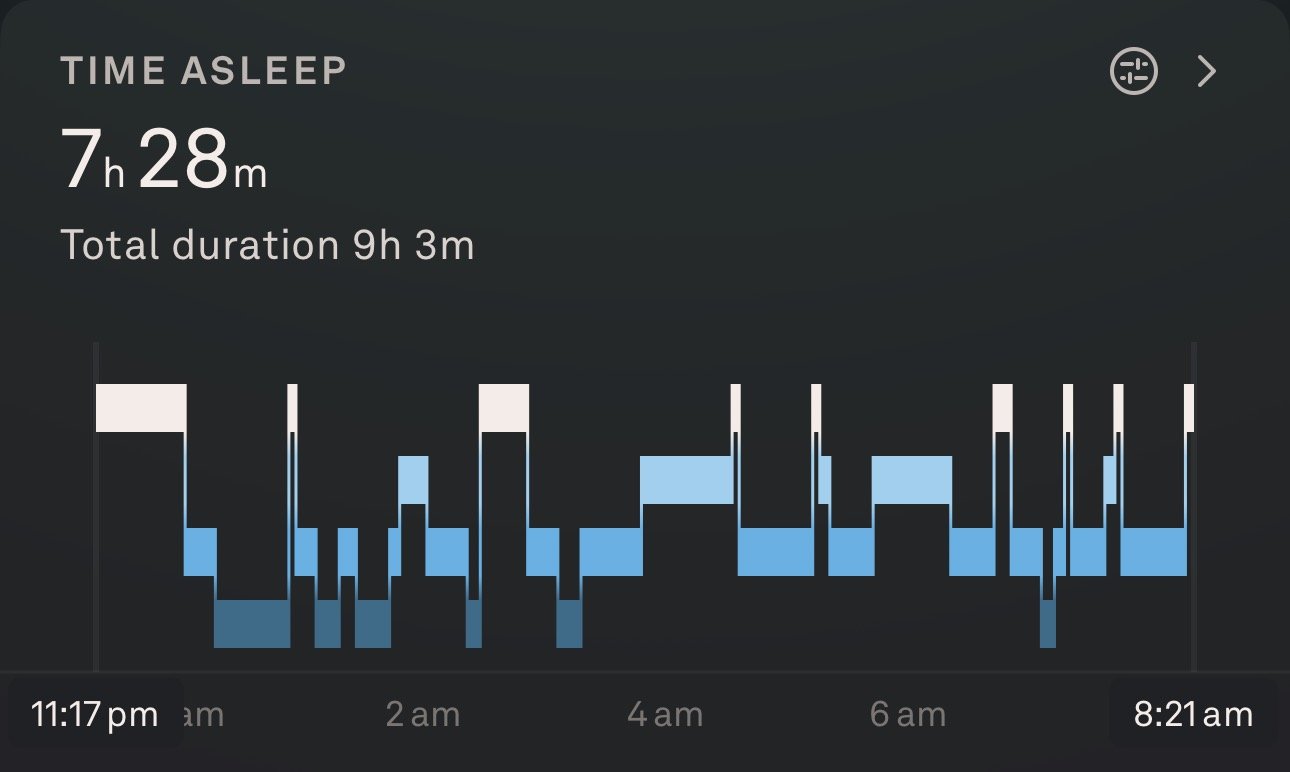
Here's what's interesting about my Oura ring data. Despite waking constantly throughout the night, my body still managed to accumulate meaningful deep sleep. And that's when the glymphatic system gets to do its most important work. That's actually a testament to how hard the body fights to get what it needs, even under imperfect conditions.
But fragmented sleep over time is a different story. The glymphatic system does its deepest work during sustained slow-wave sleep — the kind of sleep that's much more than just dozing. Think of it like trying to run a dishwasher that someone keeps opening every twenty minutes. The cleaning happens in bursts, but the cycle never fully completes. And if that pattern continues night after night, the accumulation compounds quietly in the background.
What supports glymphatic function
While researchers are still learning about all the factors that influence the glymphatic system, a few things consistently rise to the top.
Deep sleep quality matters more than most people realize.
As last night demonstrated for me, it's not always just about the total number of hours. The glymphatic system does its most important work during deep, slow-wave sleep, so protecting the conditions that allow you to reach and sustain those stages becomes the priority.
Your nervous system matters.
If your body doesn't feel safe enough to fully let go, deep sleep becomes much harder to access. That's one of the reasons I spend so much time teaching nervous system regulation — it isn't just about feeling calmer during the day. It's about creating the conditions for truly restorative sleep at night.
A consistent circadian rhythm helps.
Morning sunlight, regular sleep and wake times, and getting bright light during the day all help reinforce your body's internal clock, making quality sleep more likely.
Exercise appears to support glymphatic function over time.
Yet another reminder that movement benefits far more than just our muscles and cardiovascular system.
Sleep position may matter more than we once thought.
Research suggests that lateral, or side sleeping, appears to be the most efficient position for glymphatic drainage compared to sleeping on your back or stomach. As a side sleeper myself, I was pretty happy to read that.
Alcohol works against this process.
Although it can make you feel sleepy, alcohol suppresses the deep stages of sleep that glymphatic clearance depends on most. It may help you fall asleep, but it can reduce the restorative quality of that sleep.
The night shift your brain depends on
One of the reasons I never get tired of studying physiology is that the deeper we look, the more beautifully coordinated the body becomes. For centuries, scientists wondered how the brain cleaned itself at all. Then we discovered an entire system quietly working every night while we sleep. It's hard not to stand back in awe of that. Healing is rarely about forcing the body to work harder. It's about creating the conditions that allow it to do what it was designed to do.
Tonight when you climb into bed, try to remember this: you aren't just going to sleep. You're giving your brain permission to clean house.
And because we must follow everything upstream, it feels important to acknowledge that your brain can only do this incredible work when your body feels safe enough to surrender into deep, restorative sleep.
That's why I've dedicated this entire month inside Rooted + Rising to understanding sleep through the lens of the nervous system. If you've ever wondered why you can sleep eight hours and still wake up exhausted, why your mind won't quiet down at night, or why you've tried every sleep supplement without lasting success, we're going far deeper than sleep hygiene.
We're learning how to create the internal conditions that allow your body to do what it was beautifully designed to do.