

Why Change Feels So Dangerous (And Why You Keep Starting Over)
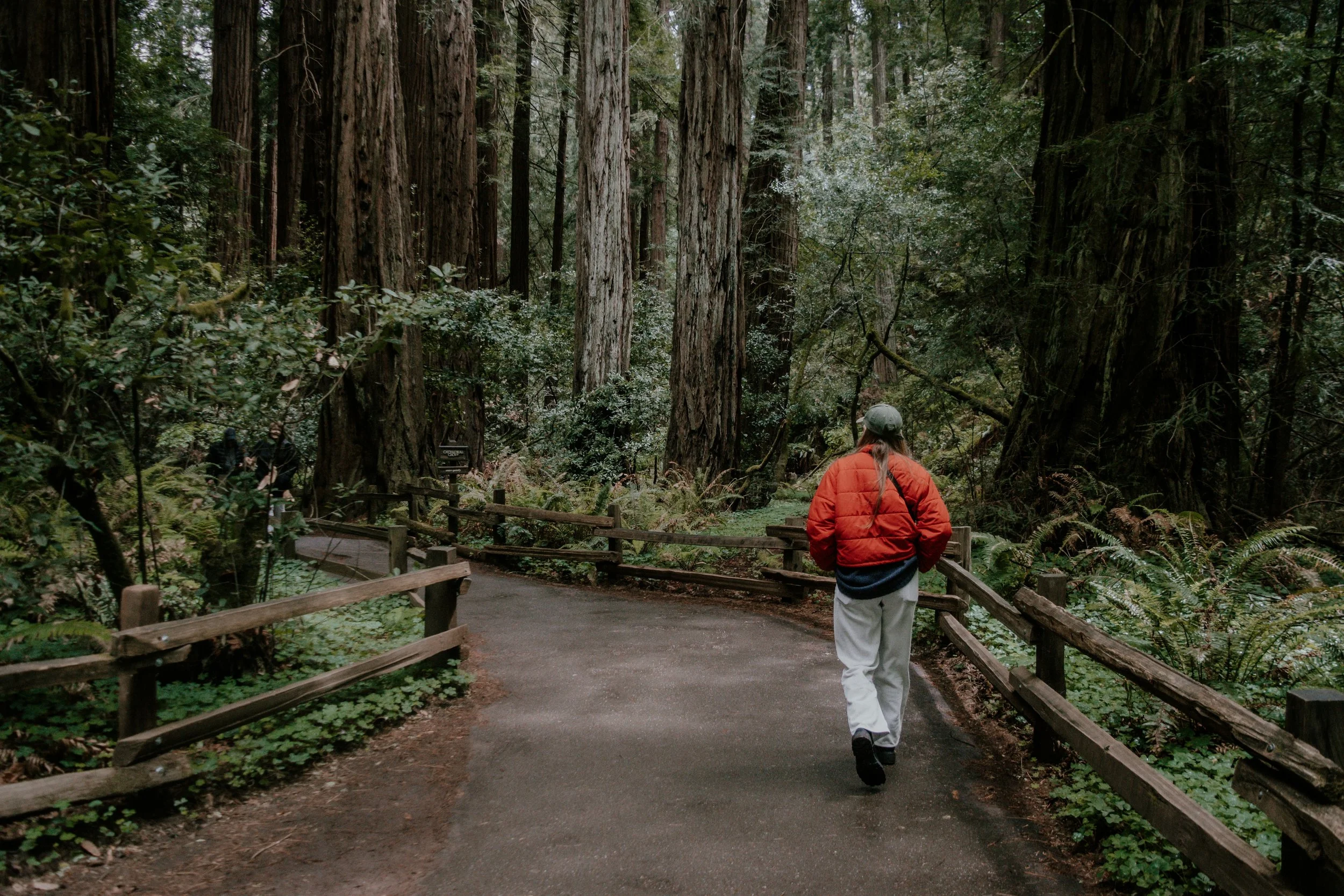
I realized something today: I haven't been taking my walks.
Life has been busy lately, and even though I fully intend to get at least a 20 minute walk in every day, I haven't been. Not even close.
Years ago, that realization would have sent me straight into a shame spiral. "Ugh, you never stick with anything." "What is wrong with you?!" "It's so simple and you can't even do that." "You must secretly hate yourself." All those thoughts would have filled me up and sapped every bit of strength I had. And then all I would want is comfort. I'd scroll on my phone, or eat something I probably shouldn't, because I just needed to feel good for a minute.
But none of that happened today. No shame thoughts. No berating myself for not getting enough movement. Just the realization, and then the thought, "I need to prioritize this. I'll go for a walk right before lunch."
And then I did. It was just that easy. (And it was a beautiful day, so the walk felt amazing.)
I want to tell you how I got from that first version of me to this one, because it took a really long time. And if you've been stuck in a stop/start cycle with something you know would help you, I want you to know there's a reason it keeps happening. It isn't that you're lazy, or that you're just built different, or that you can't change. The reason might actually surprise you.
My first "perfect schedule"
I made my first perfect schedule when I was 12 years old. Yeah I know… I was that kid.
I was homeschooled, and I had it all mapped out: wake up at 6:00, study my Bible, exercise, clean my room, start my coursework… plus whatever else I was trying to accomplish at that time.
This wasn't coming from my parents, neither of them kept a strict schedule or pushed me to. It was all me, trying to be as capable as possible.
And that’s also where my stop/start cycle began. I'd make the perfect plan, stick with it for a week or two, have one off day, and then the shame would hit with all the voices telling me I was a failure. I'd give up for weeks before I worked up the energy to start all over again with a brand new perfect plan.
I struggled with that cycle for over twenty years. And I was beyond frustrated with myself the entire time.
Maybe you have your own version. The Monday restart. The plan you made in January. The morning routine you were so excited about that lasted four days. The cold shower you fully intended to take this morning, and then didn't. (If you’re in my community this month, I see you)
It’s a very common story and one that is incredibly difficult to break free from.
It's not that you don't know what to do
We have more information at our fingertips than any generation before us. You can find a podcast, a reel, a book or a 30-day plan for literally anything you want to change. Or just ask ChatGPT or Claude for the perfect routine and it’ll whip something up for you in about 20 seconds.
For most of us, knowing is not the problem. We know we should move our bodies, get outside, and put the phone down at night. Most of that isn’t a mystery to us. The problem is knowing how to actually do it, and keep doing it.
Researchers even have a name for this: the intention-behavior gap. On average, our intentions explain less than a third of what we actually end up doing.
So if you've been thinking you just need more information, or more motivation, or more discipline, I want to offer a different explanation. Because a lot of what's getting in the way is happening in your nervous system.
Why your brain flags change as danger
Your brain's number one job is to keep you alive. Making you happy or productive comes second. Let that sink in…
One of the main ways it tries to keep you alive is by predicting. Neuroscientist Lisa Feldman Barrett describes the brain as constantly running predictions about what's going to happen next, so it can manage your body's energy before you need it. She calls it your body budget.
To keep it simple: your brain is always asking, "What happened last time? Okay, let's get ready for that."
Familiar is easy to predict. Your brain knows exactly how your old routine goes. It knows what scrolling before bed feels like, what skipping the walk feels like, what hitting snooze feels like. Even if those habits aren't benefiting you, they're known. And to your brain, known means predictable, and predictable means safe.
Change is the opposite, because change means uncertainty. And to your nervous system, uncertainty can feel more threatening than something unpleasant you already know.
In one study, researchers had people play a game where certain images on a screen might be followed by a small electric shock. The odds shifted throughout the game, so people had to keep guessing which images were the risky ones. The researchers tracked how stressed people said they felt, along with signs of stress in their bodies like pupil size and sweat on their skin. What they found was that stress rose and fell with uncertainty. People felt the most stressed, and their bodies showed it the most, when they couldn't tell whether or not a shock was coming, versus when they were pretty sure it was.
And that's exactly what change feels like to your nervous system. Your old routine might not feel great, but your brain knows exactly what to expect from it. The new thing, even if it's good for you, is full of unknowns. How will it feel? Will I be able to keep it up? What if I fail again? To your brain, that uncertainty can register as more threatening than the familiar discomfort you're already living with.
A few weeks ago I wrote about how your nervous system is a prediction machine, not a truth machine. This is that same machine at work.
I like to think of it like someone moving the furniture around in your house while you're asleep. You know your living room so well that you can walk through it in the dark without turning on a light. But if someone moved the couch, suddenly every step would feel risky, and you'd be bracing for impact the whole way through, even though nothing in the room is actually dangerous. That's what change feels like to a nervous system. Your body goes on alert and the alarms start going off, not because the change is bad, but because it's unfamiliar.
The cycle you've felt stuck in isn't a sign that something is wrong with you. It's your brain trying to protect you.
Why we stop (and why it isn't about willpower)
So let's say you push through the alarms and you start. You're doing the new thing, and it's going well. Then what happens?
For me, it was almost always the same thing: life would inevitably not go as planned. A busy week, a stressful conversation, a bad night of sleep. Something would disturb my perfect schedule and make it impossible to follow.
On top of that, the added stress meant an even stronger urge to go back to what was familiar. Researchers have found that stress pushes the brain away from goal-directed behavior and back toward habit. When your system feels stretched, it reaches for what it already knows how to do, because that takes less energy.
This is exactly what happened with my walks. Life got busy, and my nervous system went back to its default which is looking for easy comforts versus ones that require energy.
Your brain is conserving resources when it feels like it's under pressure, and that has nothing to do with your character.
And then comes the part that really keeps us stuck. You miss one day, and instead of just picking it back up, your mind says, "Well, I already blew it." Dieting researchers Janet Polivy and Peter Herman saw this pattern so often that they nicknamed it the "what-the-hell effect." One slip turns into "why bother," and the whole plan goes out the window.
And here’s the part I wish I'd known during those twenty years of that stop/start cycle. In a study that followed people as they built new habits, it took a median of 66 days for a new behavior to feel automatic, and for some people a lot longer than that. Missing a single day didn't meaningfully change the outcome.
This means that one off day (or two) doesn't erase your progress. It only feels that way when you're looking at it through the lens of shame.
How the stop/start cycle wears down self-trust
Every time you start something and then stop, your brain is collecting evidence. Over time, that evidence becomes a story about who you are. "I never follow through." "I'm just not a disciplined person." "Something must be wrong with me." That's when the doubt creeps in, and you start to see yourself as a failure.
I don't think shame itself is bad. It has a purpose. If you said something unkind about a friend behind their back and they found out, shame would be a completely appropriate response — it would make you want to make amends, and it would make you not want to do that again. It's meant to be a learning tool. But when our sense of self-worth is already on shaky ground, shame stops teaching us and starts tearing us down.
And shame feels awful. So our nervous system does what it's designed to do: it tries to get us away from the thing that hurts. That's why I'd reach for my phone or for food after one of those shame spirals. I just needed to feel better. And if starting something new means risking that feeling all over again, sometimes the safest option is just not starting at all.
Which means shame becomes one more reason change feels dangerous, and the whole cycle keeps feeding itself.
But here's something that gave me so much hope. Fifty years after they first described learned helplessness, the researchers behind it revisited their famous theory and found they'd gotten it backward. Shutting down under long-term stress turns out to be the brain's default setting, and what we actually learn is that we have some control. So if you've been telling yourself "I just can't change," it may be that your brain simply hasn't had the chance to collect evidence that you really can.
Starting so small that it felt silly
After twenty years of perfect schedules, I was out of ideas. I'd tried everything else and nothing stuck. So I decided to try something completely different: I'd start small.
I started by making my bed every day. That's it.
And honestly, it felt like so not enough. Part of me thought, what's the point? But I kept doing it.
And something started to shift — not because a made bed is magic, but because I was finally showing myself that I could do what I said I was going to do.
Psychologist Albert Bandura found that the most powerful way we build belief in ourselves is through what he called mastery experiences: actually doing the thing, even in a really small way. Its effect is stronger than encouragement or information alone.
That's what making my bed became for me: a little bit of evidence, every single day, that change was possible for me. And because it was so small, it didn't set off all the alarms. My nervous system could handle that little bit of change.
The other piece was letting go of perfect. I stopped expecting myself to do everything flawlessly, accepted that I was going to have off days, and let myself have them.
And this isn't just a nice idea. In one set of studies, people who responded to a failure with self-compassion were actually more motivated to improve. They studied longer for a retest than people who didn't. So being kind to yourself after an off day isn’t going to make you lazy. It actually makes it feel safe enough to try again.
The shame voice hasn't completely disappeared for me. It still shows up sometimes. But it feels like something outside of me now, like an alarm going off that I know I can shut off and ignore. And it shows up a lot less often. Today, with my walk, it just wasn't there at all.
This whole process is the heart of what I teach through the SAFE Framework.
First we understand why our nervous system does what it does. Then we start becoming aware of our own patterns. Then we build in small foundational steps, and we expand from there until change doesn't feel so scary anymore.
Something to sit with
If you've been stuck in the stop/start cycle for a long time, I want you to hear this: you're not lazy, and you're not a failure. Your brain has been doing its best to keep you safe. It learned to treat change as danger, which means it can also learn that change is safe. And the best way to do that is through one small step at a time.
A few questions to ask yourself this week:
Where have I been calling myself a failure when my brain was actually trying to protect me?
What's one thing so small it almost feels silly that I could do today?
When I miss a day, what do I usually tell myself?
And if you'd like some company while you practice this, that's exactly what we do in my free community. Change feels a lot safer when you're not doing it alone. (There's even a study showing that holding a trusted person's hand calms the brain's response to threat.)
Each month we take on one small challenge together, designed to help us break old patterns and learn new ones in a really safe and gentle way. This month we're doing cold showers, and next month we're starting the day with 100 jumps.
And a quick note: cold exposure isn't right for everyone. If you have a heart condition, are pregnant, have Raynaud's, or have any other health concerns, check with your doctor before you start.
About Deborah
I'm Deborah Cobb, an Integrative Health Practitioner (IHP) and a massage and craniosacral therapist (LMT, CCST) with over 20 years of hands-on experience. I spent years dealing with panic attacks no doctor could explain before I learned it was my nervous system, and now I teach people how to regulate theirs using my SAFE Framework.